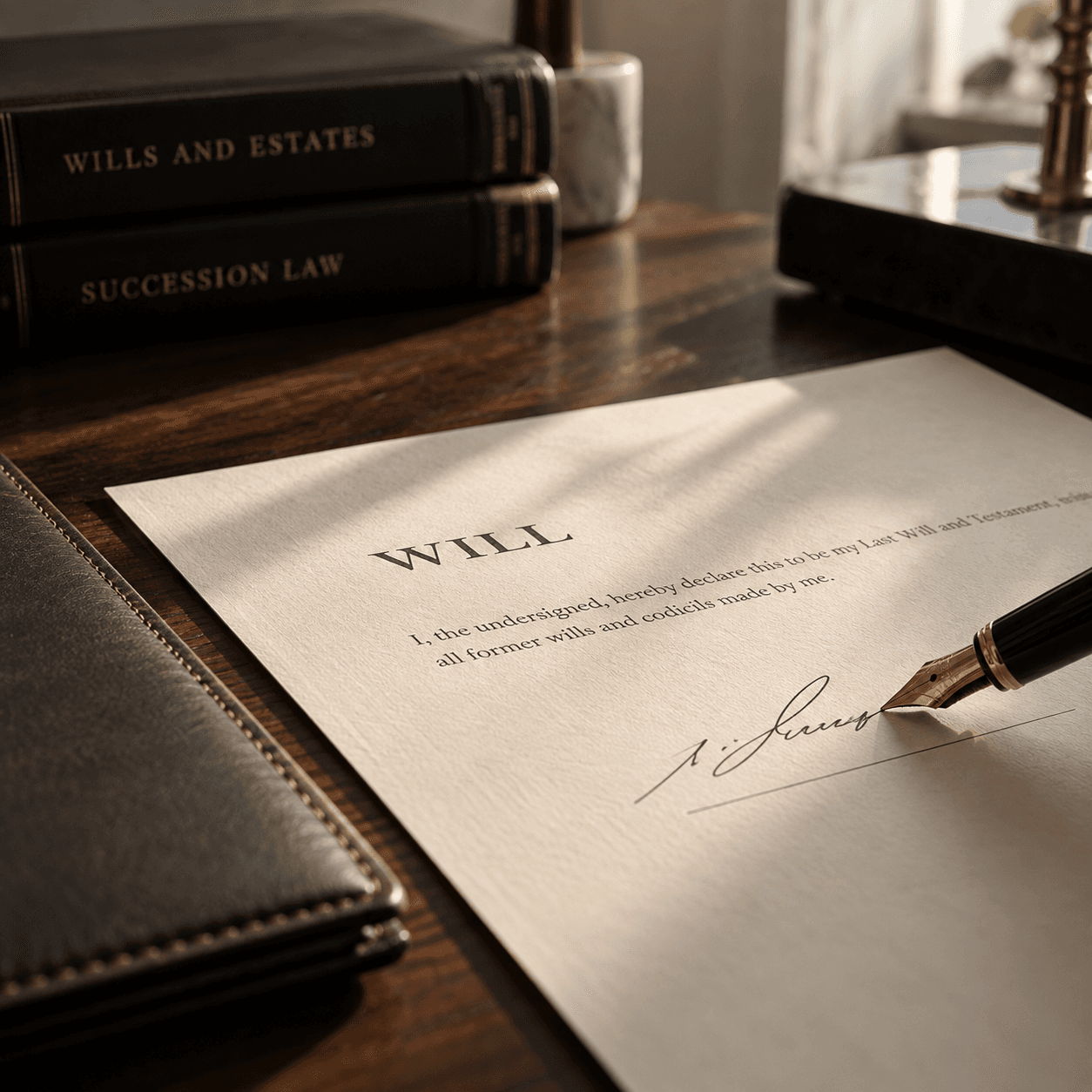
Wills
A will decides three things: who receives what you own alone, who has the job of organising it, and who looks after any children still in your care. It does nothing at all until you die, and it does nothing to assets that pass outside your estate.



- Fee
- from $440
- Timing
- Two meetings, about a fortnight
- First call
- Free, fifteen minutes
The work that sits under this heading.
- Simple wills for one person or a couple
- Testamentary trusts where a beneficiary is young, unwell or at risk
- Guardianship appointments for children under eighteen
- Blended families, second marriages and stepchildren
- Gifts to charity, and how to word them so they survive
- Reviewing a will drawn up somewhere else
From the first call to the signature.
- 01
Fifteen minutes on the phone
You tell us what you own and who is in the picture. We tell you whether a simple will covers it, and what it costs. Free, and no obligation after it.
- 02
One appointment, about an hour
We take proper instructions: assets, superannuation, jointly held property, executors, beneficiaries, and the awkward bits people would rather skip. The awkward bits are usually the ones that matter.
- 03
A draft you read at home
You get the draft in plain English with a short note explaining each clause. Take a week. Ask anything. Changes at this stage are included in the fee.
- 04
Signed and witnessed properly
We witness the signing ourselves, here or wherever suits. The original goes into our safe, catalogued, and you leave with certified copies.
Everything in the fee.
- Your will, drafted and explained clause by clause
- A written executor guide so the job is not a mystery
- Witnessing by two independent witnesses, done correctly
- Free storage of the signed original in the firm’s safe
- Certified copies for you, and a digital copy on request
Usually not. Superannuation is held by your fund, not by you, and is paid at the trustee’s discretion unless you have made a binding death benefit nomination. We check your nomination as part of the will, because a valid will and a lapsed nomination are a common and expensive combination.
If you hold it as joint tenants it passes to the survivor automatically and your will has no say in it. If you hold it as tenants in common, your share does pass under your will. We check the title rather than guess.
On a marriage, a separation, a death in the family, a birth, or a significant change in what you own. Otherwise every five years is a sensible habit. A review is far cheaper than a new will.
You can. Most of the disputed estates we see began with one. The saving is about four hundred dollars and the cost of getting it wrong is measured in tens of thousands.